
Trump, Alexander & Aristotle
JEFFREY ST. CLAIR
+ That Demosthenes of the MAGA movement, Steve Bannon, has reversed himself on the Iran war and is now, as Gen. David Petraeus said to his lover/biographer, “all in:” “President Trump’s in. We’re in, too. We’re gonna go back and re-do what Alexander the Great did 2,300 years ago.” The image of Trump as Alexander is worthy of a cartoon by Gary Larson or R. Crumb. Imagine the size of the crane necessary to hoist Trump’s gargantuan girth onto the back of poor Bucephalus, the world’s most famous war horse.
After Alexander’s army subdued Persepolis, the spiritual capital of the Achaemenid Persian Empire for more than two centuries, he ordered the ancient city annihilated, in a reenactment of the genocidal destruction of Melos during the Peloponnesian War–a shocking act of depravity that many of Alexander’s admirers in the manosophere of the classical age, desperate to portray him as an enlightened despot, a philosopher king, blamed on a woman, a courtesan named Thaīs. Thaîs, a hetaira from Athens, was, along with Alexander’s childhood friend and lover Hesphastion, the Macedonian warlord’s most intimate companion during his rampages across Asia Minor and the Subcontinent. According to the Greek historian Cleitarchus, a near contemporary of Alexander, Thaīs instigated the destruction of Persepolis, claiming that she used her erotic charms to seduce the young tyrant into burning the capital in revenge for Xerxes’s destruction of Athens in 480 BCE, one hundred and fifty years before Alexander’s army routed Darius and ended the Achaemenid dynasty.
The historian Diodorus Siculus reprised Cleitarchus’ misogynistic account in 80 BCE, at a time when Julius Caesar was beginning to view himself as Alexander reincarnate: “It was most remarkable that the impious act of Xerxes, king of the Persians, against the acropolis at Athens should have been repaid in kind after many years by one woman, a citizen of the land which had suffered it, and in sport.”
The truth is that Alexander almost certainly burned the city himself “in sport” and probably drunk, as was his violent custom. The burning of Persepolis was less about revenge for past wrongs than a brutal warning to other cities and empires that might resist against Macedonian hegemony. Alexander and his father, Philip II, had burned plenty of Greek cities in their conquest of Greece. Philip razed Aristotle’s hometown of Stagira and Alexander demolished Thebes. Later, the boy tyrant would burn and loot his way across the Levant, Palestine, Iraq, Egypt, Afghanistan and India. It’s what being a “world conqueror” is all about, as the Romans showed when they destroyed Carthage in 146 BCE and, according to legend if not fact, sowed the ground with salt so that the Punic capital could never again rise to threaten the Empire.
I’ve always been drawn to the theory that Aristotle, one of the first mycologists, arranged the assassination of Alexander of Macedon by shipping poisonous mushrooms, with detailed instructions on how to prepare them, to Babylon, after the great ethicist witnessed in horror what a genocidal psychopath his former student had become, after the burning of Persepolis and the murder in a drunken rage of his friend Cleitus the Black, who had saved his life at the crucial Battle of Granicus.
After Alexander’s death, Aristotle was chased out of the Lyceum by Athenians, who were now free to vent their anger against anyone associated with the heavy-handed hegemon from Pella. Apparently, the Athenians were unimpressed by the claims that AlexanderThaīs incinerated Persepolis on their behalf. and with good reason because the Macedonians had, in fact, allied themselves with Xerxes during the second Persian invasion and the sacking of Athens. (As for Thais, she didn’t return to Athens, but instead married Alexander’s leading general, Ptolemy, moved to Alexandria and gave birth to the dynasty that would rule Egypt until Octavian and Marius defeated Cleopatra and Marc Antony at Actium in 30 BCE.)
Saying he fled Athens to prevent Athenians from “sinning twice against philosophy” (ie, killing him after having executed Socrates), Aristotle spent the last year of his life on his mother’s old estate in Chalcis, where he died at 67 of a mysterious stomach ailment in 322 BCE. (Was he poisoned in retaliation for poisoning Alexander?)
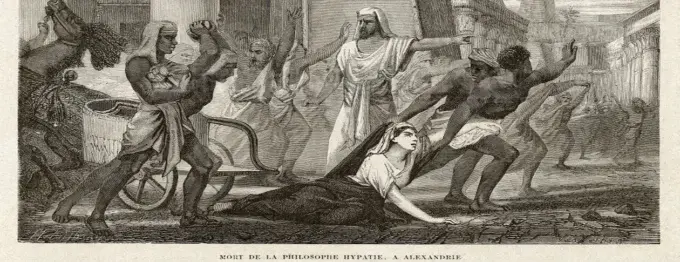
The text of Aristotle’s remarkable will, which is clearer than any written by an estate lawyer these days, was preserved by two Muslim scholars (Al Garib and Ishaq bin Hunayn), who chose to record and translate the last testament of the conqueror’s teacher. It’s highly unlikely the Christians would have done the same. In fact, in 392, Theophilius of Alexandria, a Bishop of the Christian Church, destroyed the Serapeum and urged Christian mobs to ransack the last Neo-Platonist school in the city and murder its leader, Hypatia, one of the first (that we know of) female philosophers and mathematicians.
COUNTERPUNCH
posted by Ricky at 18:56
linkar para este post



